Ever wonder why that "professional" epoxy floor your neighbor got last summer is already peeling under their tires? It’s a frustrating: and expensive: sight to see a major home investment literally flake away in less than a year. If you’re looking to elevate your garage or industrial space, you deserve a floor that doesn't just look pretty for a week but stands the test of time, salt, and heavy machinery.
At Polzin Epoxy Designs, we’ve spent over 30 years perfecting the art and science of high-performance coatings. We’ve seen it all: the good, the bad, and the downright ugly shortcuts that other installers take to finish a job in record time. Today, we’re pulling back the curtain on the industry.
Before you sign a contract, you need to know the seven critical mistakes common installers make: and exactly how we shield your investment from these avoidable failures.
1. The Acid Etching Shortcut: A Recipe for Disaster
Do you want a floor that sticks like a sticker or one that bonds like a weld? Many "pro" installers still rely on acid etching to prepare concrete. They pour a muriatic acid solution on your floor, let it fizz, and wash it off.
The Mistake: Acid etching is a surface-level treatment. It doesn't open the "pores" of the concrete deep enough for the epoxy to truly bite. Worse, if the acid isn't neutralized and dried perfectly, it leaves behind moisture and salts that actively destroy the bond from underneath.
The Polzin Fix: We never take the easy way out. We utilize mechanical diamond grinding to achieve a specific Concrete Surface Profile (CSP). By grinding away the weak "cream" layer of the concrete, we expose the strong aggregate, allowing our premium coatings to penetrate deep into the slab.
Learn more about the truth between grinding vs. acid etching here.

2. Playing "Hide and Seek" with Moisture
Concrete might look dry on top, but it acts like a sponge, holding onto vapor that wants to escape.
The Mistake: Most installers walk onto a site, see a dry-looking floor, and start mixing. If they don't perform a moisture vapor transmission test, they are gambling with your money. When that trapped vapor tries to rise, it creates hydrostatic pressure that causes the epoxy to bubble, blister, and pop.
The Polzin Fix: We treat moisture as the "invisible killer" of coatings. Our process includes testing for moisture levels and, when necessary, installing a specialized vapor barrier basecoat. This high-solids layer is designed to withstand significant pressure, ensuring your floor stays flat and beautiful regardless of Wisconsin’s changing water table.
Read more on why moisture matters in floor coatings.
3. The Dust Barrier: Leaving the Bond-Breakers Behind
You can spend thousands on the world’s best epoxy, but if you apply it over a layer of dust, you’ve just bought a very expensive rug that isn't attached to anything.
The Mistake: After grinding, the floor is covered in fine concrete dust. Many installers do a quick sweep or use a standard shop-vac. This leaves microscopic particles in the pores. The epoxy bonds to the dust, not the concrete. The result? Sheet-style delamination where the coating peels off in large, clean pieces.
The Polzin Fix: We use industrial-grade HEPA-filtered vacuum systems connected directly to our grinders. After grinding, we perform multiple passes of vacuuming and "tack-ragging" to ensure the slab is clinically clean. When we pour our material, it touches nothing but pure, open concrete.
4. "Eyeballing" the Chemistry
Epoxy is a chemical reaction, not just a bucket of paint. It requires a precise ratio of Part A (Resin) and Part B (Hardener).
The Mistake: In a rush to finish, some installers "eyeball" the mix or fail to mix the components for the full required time. This leads to "soft spots": areas of the floor that never fully cure. These spots remain tacky, attract dirt, and will eventually fail under the weight of a vehicle.
The Polzin Fix: Precision is our middle name. We use measured mixing stations and high-torque electric mixers to ensure every drop of material is chemically balanced. We even transfer our mixed material into a second clean bucket to ensure that any unmixed resin on the sides of the first bucket never makes it to your floor.

5. Skipping the Foundation: The Missing Primer
Would you build a house without a foundation? Of course not. So why would you apply a floor coating without a primer?
The Mistake: To save on material costs and labor time, some installers go straight to the "build coat" or the color coat. Without a dedicated primer, the concrete often "out-gasses," releasing air that creates tiny pinholes in your finished floor.
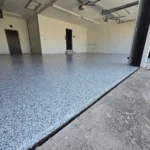
The Polzin Fix: Every high-quality Full Flake Coating we install starts with a deep-penetrating primer. This layer seals the concrete, prevents air bubbles, and creates a "chemical bridge" between the slab and the decorative layers. It's the difference between a floor that lasts 5 years and one that lasts 30.
6. The "One-Day" Speed Trap
We see the ads everywhere: "Garage floors in just 24 hours!" While modern polyaspartics are fast-curing, rushing the process can lead to long-term failure.
The Mistake: Installers often ignore environmental factors like Wisconsin's high humidity or cold snaps. If it’s too humid, the coating can "amine blush," leaving a greasy, milky film on the surface. If it’s too cold, it may never bond correctly. Rushing the cure time to get to the next job often means the installer is ignoring the manufacturer's strict environmental guidelines.
The Polzin Fix: We monitor the ambient temperature, slab temperature, and dew point on every single job. We use climate-specific formulas: adjusting our chemistry to match the season. We prioritize a professional, high-quality installation over a "fast-and-cheap" one every single time.

7. Stretching the Material: The "Thin-Coat" Deception
Material is the most expensive part of a high-quality floor. Naturally, low-bid installers try to use as little of it as possible.
The Mistake: They stretch the material thin, resulting in a low "dry film thickness." A thin floor has no impact resistance. Drop a wrench, and it chips through to the concrete. Drive a car with hot tires on it, and the heat pulls the thin coating right off the slab (known as hot-tire pickup).
The Polzin Fix: We believe in transparency and durability. We apply our materials at the manufacturer-recommended spread rates: and often thicker. Our multi-layer systems, including a thick broadcast of vinyl flakes and a heavy-duty UV-stable topcoat, provide a cushioned, durable surface that laughs at dropped tools and hot tires.
Why Polzin Epoxy Designs?
Choosing an installer shouldn't be a guessing game. When you choose us, you aren't just getting a crew with a bucket; you're getting:
- 30 Years of Industry Expertise: We’ve solved every concrete problem imaginable.
- Wisconsin Roots: We understand the salt, snow, and temperature swings our floors must endure.
- Family-Owned Integrity: Our name is on the line with every project. We treat your garage like it’s our own.
Stop Settling for "Good Enough"
Is your garage floor ready for a transformation? Don't let a "shortcut specialist" ruin your concrete. Act now to ensure your floor is handled by the experts who do it right the first time.
Revitalize your space: Contact Polzin Epoxy Designs today for a free, professional consultation!